The 2G Shutdown Is Here: What It Means for Your Gate Opener
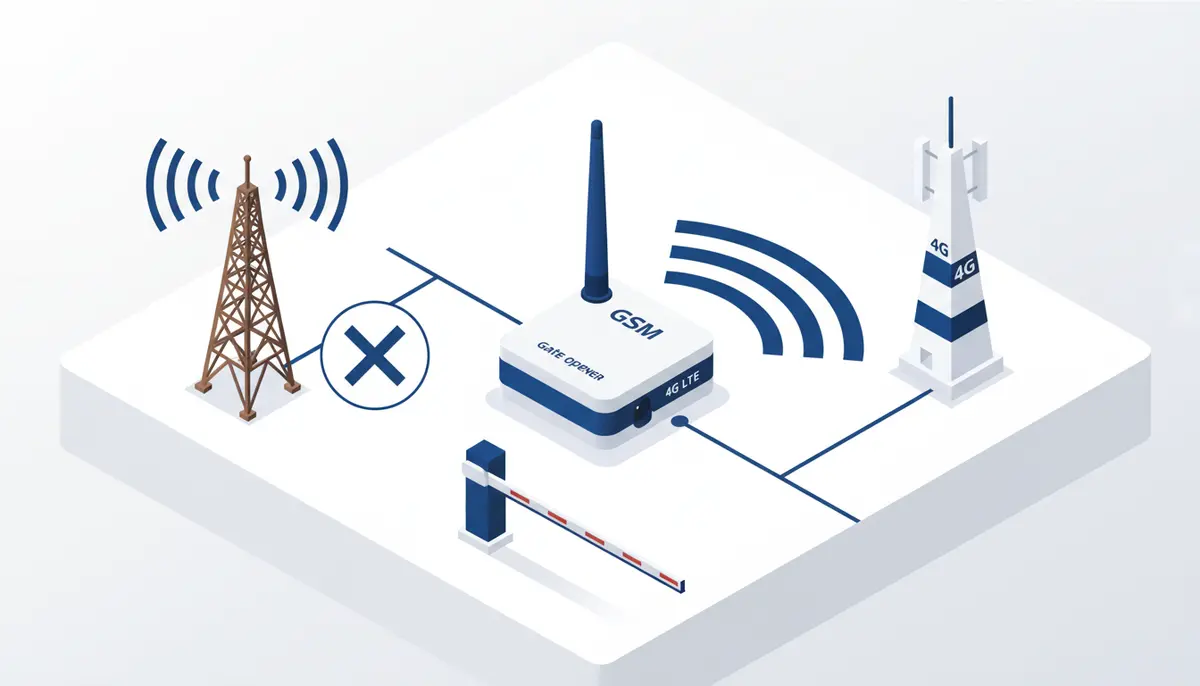
The 2G network shutdown is happening globally. Carriers in the US, Europe, and Asia are switching off 2G for 4G and 5G. If your GSM gate opener runs on 2G, it will stop working. This guide covers shutdown timelines by country, how to spot fake '4G' modules, and upgrading to genuine 4G.
Your gate opener worked fine for years. Then one morning it doesn't respond to calls or SMS. The power light is on, the SIM has credit, but nothing happens. If your carrier recently shut down its 2G network, that's why. Your module isn't broken. The network it depends on is gone.
What Is the 2G Shutdown?
The 2G shutdown is the global process of mobile carriers switching off their legacy GSM networks to free up radio spectrum for 4G LTE and 5G. According to the GSA (Global mobile Suppliers Association), 19 countries have completed full nationwide 2G shutdowns as of early 2025, with dozens more scheduled through 2030. GSM gate opener modules like the RTU5024, Callny G202, and similar devices depend on 2G to receive SMS commands and phone calls. When 2G disappears in your area, these modules lose connectivity entirely.
This is not a gradual slowdown. 2G carries just 0.1 bits per second per Hz of spectrum, compared to 2.4 for 4G. According to Onomondo's LTE-M analysis, a gigabyte of data uses up to 100 times less energy to transmit over modern networks than 2G. Carriers have no reason to keep it running. When they flip the switch, every 2G-only device on that network goes silent.
When Is 2G Shutting Down in Your Country?
The timeline varies widely. Some countries finished years ago. Others won't start until 2029. Here's where things stand as of April 2026, based on data from the GSA switch-off tracker and individual carrier announcements.
Already Complete
| Country | 2G Shutdown |
|---|---|
| Japan | 2012 |
| Australia | 2018 |
| Singapore | 2017 |
| South Korea | 2021 |
| Canada | 2021 |
| Switzerland | 2023 |
| US (AT&T) | 2017 |
| US (T-Mobile) | 2025 (in progress) |
Europe: Scheduled Shutdowns
| Country | Carrier | Shutdown Date |
|---|---|---|
| Netherlands | Vodafone, Odido | End of 2025 |
| Netherlands | KPN | December 2027 |
| Ireland | Vodafone, Three | December 2025 |
| Spain | Telefonica, Vodafone | End of 2025 |
| France | Orange | March-Fall 2026 |
| France | Bouygues | End of 2026 |
| Norway | Telia | Aug-Dec 2025 |
| Sweden | Net4Mobility | December 2025 |
| Germany | Deutsche Telekom | June 2028 |
| Germany | Vodafone | September 2028 |
| UK | EE | May 2029 |
| UK | Vodafone/Three | Spring 2030 |
| Finland | All carriers | End of 2029 (government mandate) |
According to Vodafone's network modernization announcement, shutting down 2G frees up spectrum that delivers faster speeds and better indoor coverage for 4G and 5G customers. For gate opener owners, the practical question is simple: check your carrier's timeline, and plan your upgrade before the switch-off date.
Beware of "4G" Gate Openers That Aren't Really 4G
Here's something most upgrade guides won't tell you. Many cheap GSM gate opener modules sold on AliExpress and Amazon as "4G" are not genuine 4G devices. They're 2G modules with misleading labels.
Known fake "4G" modules
- Callny G202 Plus "4G" contains only 2G internals despite 4G marketing on both the product listing and the device casing.
- Some RTU5024 "4G" variants use a Quectel EC25 chipset that supports 4G data, but 4G voice (VoLTE) and SMS have not been enabled in the firmware. These will fail when 2G shuts down.
How to verify your module is genuinely 4G:
- Check the frequency bands. If the specs list only 850/900/1800/1900 MHz, it's a 2G module regardless of the label. Real 4G modules list LTE bands like B1, B3, B5, B7, B8, B20.
- Check for VoLTE support. The module must support voice over LTE for phone-call gate opening to work on 4G networks.
- Check the chipset. Quectel EC25 (with enabled 4G firmware), SIMCOM SIM7600, or any LTE Cat1bis Rel13+ chipset are legitimate.
How to Upgrade Your Gate Opener to 4G
Genuine 4G gate opener modules are available as direct replacements. The RTU5024 4G from King Pigeon/BLIIoT uses the same enclosure, wiring, and SMS commands as the 2G version. Other verified 4G options include the AES i-Gate series (LTE Cat1bis, 250 users) and the BLIIoT RTU5022 4G for industrial applications.
- 1.Power off the old 2G module
- 2.Remove the SIM card and antenna
- 3.Mount the new 4G module in the same location (same screw holes on RTU5024)
- 4.Connect the same power and relay wires (identical terminal layout)
- 5.Insert the SIM and attach the antenna
- 6.Power on and wait for the SIGNAL LED to stabilize
- 7.Reconfigure your password, authorized users, and relay timing (settings don't transfer between modules)
SIM card check
You may need a new SIM card with VoLTE/4G support from your carrier. Older SIMs provisioned for 2G-only may not negotiate a 4G connection. Contact your carrier and confirm the SIM supports VoLTE before installing it in the new module.
For a detailed step-by-step walkthrough, see the RTU5024 setup guide. The 4G model follows the same process.
Future-Proof Your Gate Access with GateOpener
Every SMS command your old 2G module understood, your new 4G module understands too. The RTU5024 4G uses identical command syntax. Callny 4G variants use the same Callny protocol. GateOpener supports both protocol families across all network generations.
When you upgrade your hardware from 2G to 4G, your GateOpener setup stays the same. Just update the module's SIM number if it changed. Everything else carries over: your gate names, user lists, relay timing preferences, and one-tap widget.
- Works with 60+ modules, including all 4G variants of RTU5024 and Callny
- Manage 2G and 4G modules side by side during your migration
- One-tap widget opens your gate in under 2 seconds, regardless of network
- EUR 5.99 one-time, no subscription, no cloud, no account
Frequently Asked Questions
Will my gate opener stop working immediately when 2G shuts down?
Yes. 2G-only modules cannot fall back to 4G or 5G. When the carrier switches off 2G in your area, the module loses connectivity completely. There is no gradual degradation. It's instant.
My module says "4G" on the box. Am I safe?
Not necessarily. Many cheap modules are mislabeled. Check the actual frequency bands in the specs, not the marketing label. If only 850/900/1800/1900 MHz bands are listed, it's a 2G module. See the fake 4G section above for details.
Can I just put a 4G SIM in my 2G gate opener?
No. The limitation is the modem hardware inside the module, not the SIM card. A 2G modem physically cannot connect to a 4G network. You need a new module with a 4G modem.
Does GateOpener work with 4G gate opener modules?
Yes. GateOpener works with all RTU5024 and Callny protocol variants, including 4G LTE models. The app sends SMS commands and makes phone calls regardless of the underlying network technology. See the full hardware compatibility list.
When should I upgrade?
Check the shutdown timeline for your country and carrier. If the shutdown is within the next 1-2 years, upgrade now. If you're buying a new module for any reason, choose 4G. The EUR 10-15 price difference is insignificant compared to replacing the module again later.
Sources
Industry Reports
Carrier Announcements
Technical References
Ready to ditch SMS commands?
GateOpener replaces cryptic codes with a clean interface. One app for every GSM gate module. No subscription, no account needed.
Related posts
RTU5024 4G vs 2G: Do You Need the LTE Version?
RTU5024 4G vs 2G compared: identical SMS commands, different modem. 2G shutdown timelines for 10+ countries, when to buy 4G, and step-by-step migration.
Which SIM Card Works Best for GSM Gate Openers?
SIM card guide for GSM gate openers: 4 SIM sizes compared, prepaid vs contract, PIN removal, 2G shutdown dates for 10+ countries, and carrier picks for UK, NL, DE, US, FR.
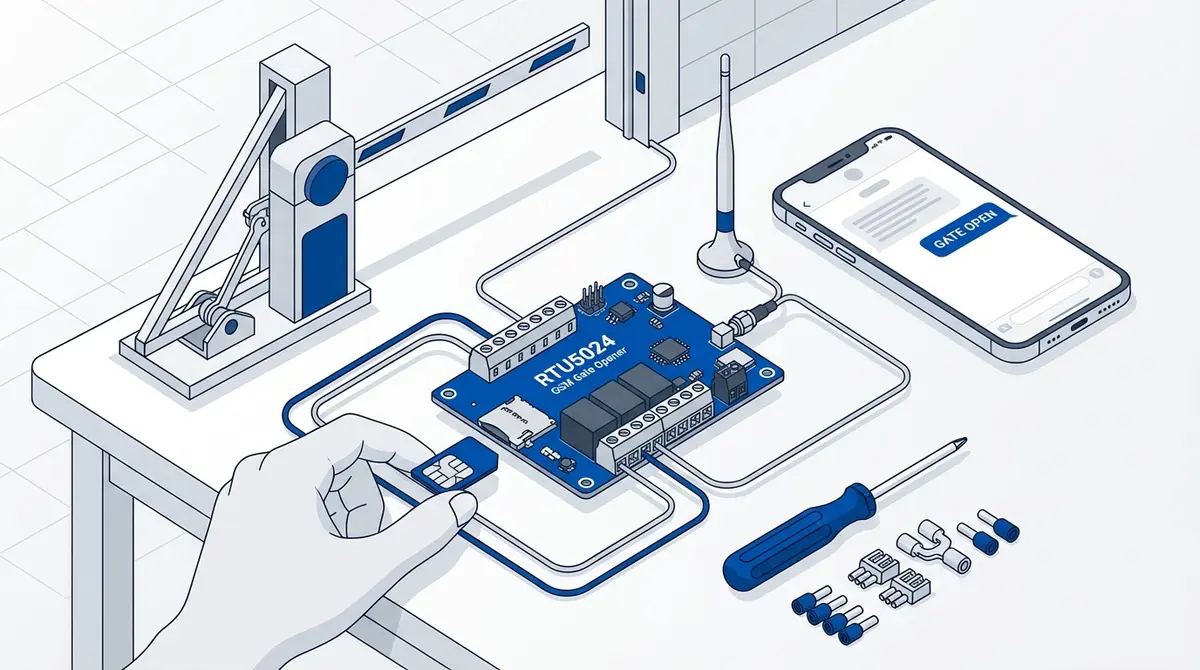
How to Set Up Your RTU5024 GSM Gate Opener
Complete RTU5024 setup guide: SIM card prep, relay wiring, password change, adding users, and testing. Covers all RTU5024 variants with step-by-step SMS commands.